AI Engineering · SDET · Testing · Evaluation · AIDLC · Production AI · AI Architecture · Software Development
The SDET Role Did Not Die. It Moved Up the Stack.
By Ramesh Nori · November 26, 2026 · 8 min read
The question comes up every time I talk to an SDET or a QA lead working on an AI product. Should I be worried? Claude writes unit tests faster than their engineers. Cursor scaffolds mocks in seconds. Copilot generates integration test boilerplate before anyone even opens the ticket. If writing tests is the job, the job is being eaten.
The short answer I give them: the commodity half of the SDET job is being eaten, fast. The interesting half has never been more valuable. What SDETs need is to walk toward the interesting half with intent, before their teams get flattened into "people who write tests the assistant could have written."
I have been thinking about this for months, mostly while watching AI projects ship with testing practices that were designed for a world where software was deterministic. Call it the AI development lifecycle, AIDLC, or just "that is not how models work." The testing paradigm has to change. The projects that work have figured something out. The projects that stall have not. I want to write down what I have seen the ones that work do differently.
What is actually being commoditized
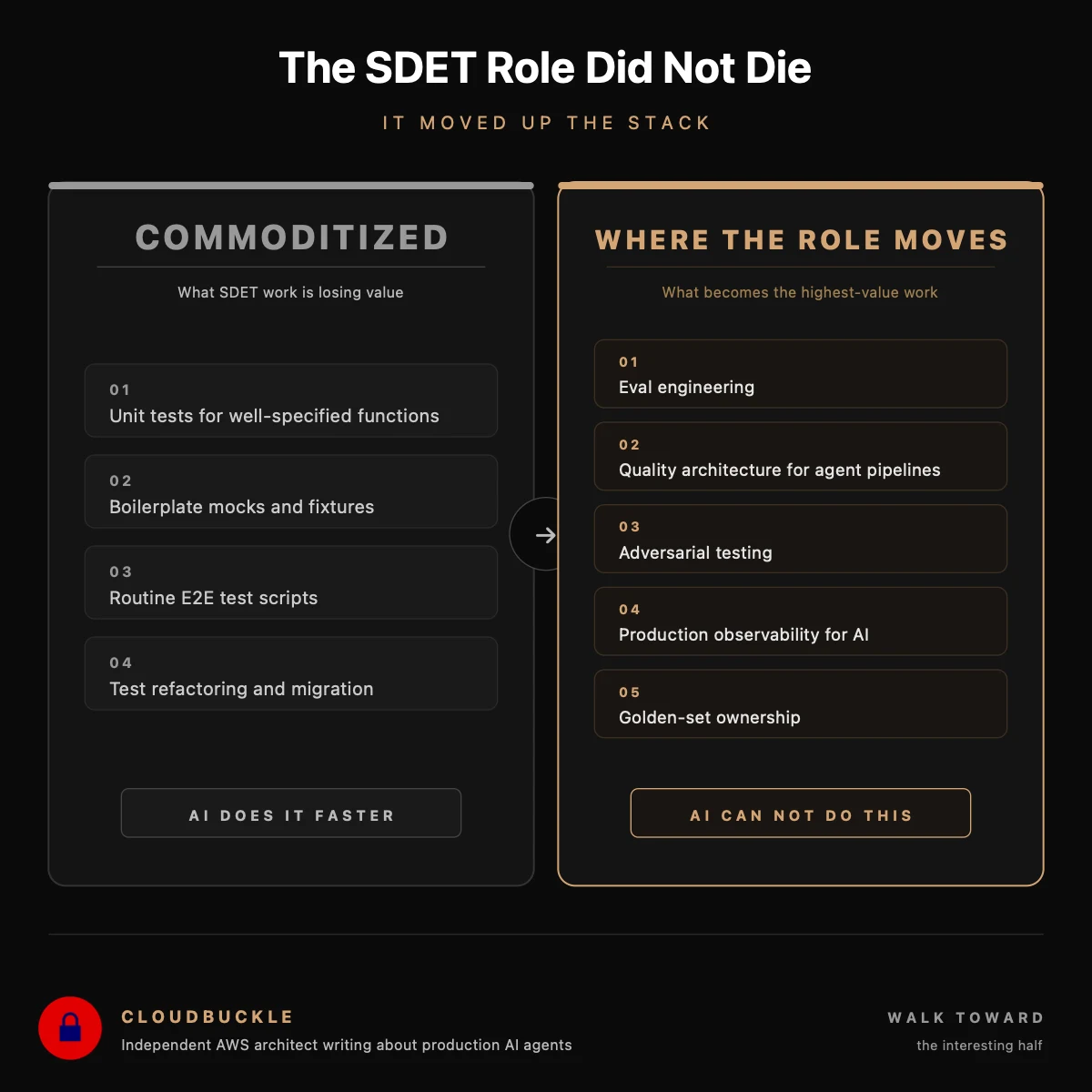
Not the SDET. Four specific pieces of SDET work that a coding assistant does better than most humans.
Unit tests for well-specified functions. If a function has a clear input and output contract, Claude and Cursor generate more test cases than a human would bother writing, including edge cases humans forget. A senior SDET spending an hour writing unit tests for a parser is spending an hour poorly.
Boilerplate mocks and fixtures. Mock data generation, test doubles for standard interfaces, HTTP mock scaffolding. The assistant produces these in the time it takes to describe them.
Routine E2E test scripts. For deterministic UIs with stable selectors, Playwright and Cypress scripts generated from a prose description of the user journey are mostly correct on the first try.
Test refactoring and migration. Converting one framework to another, updating assertions across a thousand files, adding type hints to legacy test suites. This is the boring work AI does well.
If your team is still hand-writing this work, the economic argument against your team gets harder every month. Not because the tests are bad. Because they could be generated faster, cheaper, and more comprehensively.
What is not being commoditized
Five things, and this is where the role moves.
Eval engineering for non-deterministic systems. LLMs do not pass or fail on asserts. The same prompt returns different answers across runs. Agent workflows have fifteen decision points, each with a probability distribution. Testing them with assertEquals is a category error. What they need is an eval framework: a golden dataset, a scoring rubric, calibrated metrics, and a workflow for triaging regressions. This is the single most valuable piece of work on any production AI team, and most teams I have talked to do not have someone owning it.
Quality architecture for agent pipelines. Where in the sync-thin, async-fat split do tests go? Pre-classifier gates like the ones I described in the Jev piece need their own eval set. Post-LLM output validation is a different eval problem. Shadow mode comparisons against a new model version are a third. Canary cohorts for specific user segments are a fourth. Deciding where each kind of test lives, who owns it, and what the regression signal looks like is architectural work. It is also the exact work SDETs who moved up the stack are doing.
Adversarial testing. Prompt injection attempts, jailbreak probes, policy-boundary tests, out-of-distribution inputs that break the model's assumptions. Coding assistants are not good at generating these because they share the model's blind spots. Humans who think adversarially are still the right tool. SDETs are already pattern-matched on adversarial thinking. They are the natural home for this work.
Production observability for model behavior. Traditional application logs do not catch "the model started hallucinating last Tuesday after we updated the retrieval index." What catches that is calibration drift monitoring, prompt-regression tests on a scheduled cadence, and anomaly detection on the eval scores themselves. The infrastructure to catch quality regressions in production belongs to whoever owns quality. In most orgs, that used to be the SDET team. In the ones that work, it still is.
Golden-set curation and maintenance. The single most valuable artifact on any production AI team is the eval set. The questions you have decided matter, with the answers that are correct, in the format that enables comparisons. Every team I have seen that ships reliable AI has one. Every team that struggles does not. Nobody owns it on most teams because everyone assumes someone else will. SDETs are the role that should own it, and the ones who do are the ones their teams cannot replace.
What to learn
If the SDET role is moving up the stack, these are the skills that let you move with it. Not academic lists. Specific things you can start on this quarter.
Eval framework design. Pick one tool and learn it well. promptfoo is open source and runnable on a laptop. LangSmith is the hosted option most teams end up with. Weights and Biases has eval tooling that extends to agents. Build an eval set for a real workflow. Do not stop until you can detect a regression that a human reviewer would notice.
Statistical thinking. A/B tests, confidence intervals, calibration, reliability diagrams. Not because you will run experiments every day, but because you need to reason about non-deterministic outputs. If a prompt change improves scores from 0.82 to 0.85, is that a real improvement or sample noise? Teams that cannot answer this question ship the wrong model to production.
LLM-as-judge patterns. Using an LLM to grade another LLM's output is an obvious idea that works until it does not. Learn where it works (rubric-based scoring on well-defined criteria), where it fails (preference judgment, factuality for domain knowledge), and how to detect that the judge itself has drifted.
Agent trace analysis. When an agent misbehaves, the trace of its tool calls and reasoning is the evidence. Learning to read these traces, find the decision point that went wrong, and feed it back into the eval set is a core SDET skill in the agent era.
Observability for AI systems. OpenTelemetry for LLM calls, custom metrics for model behavior, dashboards for calibration drift. Build one for a real system. Learn what regresses in production and what does not.
What to unlearn
Just as important.
Stop treating tests as pass/fail artifacts. They are specifications of what good looks like. For a non-deterministic system, a test is a probability threshold, not a hard assertion. Writing them with the wrong mental model is why so many AI projects have "tests" that do not actually detect regressions.
Stop writing the test pyramid. Unit, integration, E2E, in that ratio. For agent systems, the pyramid is wrong. More useful: eval set, adversarial set, production canary set. Different shape, different ownership, different signal.
Stop hand-writing unit tests for code the assistant could write. This feels like heresy if hand-writing tests is your discipline. It is not heresy. It is reallocation. The assistant writes unit tests, you design the eval set that catches the thing the unit tests cannot.
Stop believing you can test determinism into a non-deterministic system. The temptation to pin a seed, mock the model, and assert on output is strong. Teams that do this are testing the pin, not the system. Learn to accept that your tests will be probabilistic and design for that reality.
Three patterns worth adopting
If you are an SDET reading this and wondering what to do Monday morning, three patterns are the ones to adopt first.
Pattern 1: Own the golden set. Volunteer to own the eval dataset for your team's AI feature. Curate the questions, maintain the expected answers, build the comparison tooling, run the regressions on every prompt change. This single piece of work makes you indispensable within one sprint.
Pattern 2: Move your test design one step earlier. Instead of writing tests after the feature is specified, write the eval criteria as part of the spec itself. Work with the PM on acceptance criteria that are not binary. Work with the architect on where in the pipeline each quality gate lives. This is the FDE-flavored shape of the role, applied to testing.
Pattern 3: Instrument production before you instrument tests. For any AI feature, stand up calibration drift monitoring and prompt-regression alerts in production before you obsess over the pre-prod test suite. The production signal tells you what to test. The pre-prod suite tells you what you thought you should test. These are not the same thing.
The bottom line
The SDET role is not dying. The half of it that writing tests by hand defined is being commoditized, fast. The half of it that comes from thinking clearly about what quality means for a non-deterministic system is the most valuable work on any production AI team.
If you are an SDET, the move is to stop defending the territory assistants are taking and to walk toward the territory they cannot. Eval engineering, quality architecture, adversarial testing, production observability for AI, and golden-set ownership. Each one of these is a role that most teams do not have filled. Each one is a career trajectory that gets more valuable as more companies ship AI systems and realize they cannot measure whether those systems work.
I have written before about the three seats on an AI project: architect, PM, and FDE. The SDET of the next few years is not a fourth seat. The SDET of the next few years is the person in whichever seat owns quality for a non-deterministic system. That might be a specialist title, it might be the FDE with a testing background, it might be a new role your org has not named yet. Whatever the title, the work is the same, and it is the most valuable work on the team.
The question is not whether to make the move. The question is whether you make it this year or next.
Written by Ramesh Nori. If this was useful or you have feedback, reach me at cloudbuckle@gmail.com.