AI Architecture · Agentic AI · Production AI · LLM · Classifiers · Bedrock · Guardrails · AWS
Jev Named an Underused Pattern in Agent Architecture.
By Ramesh Nori · September 25, 2026 · 8 min read
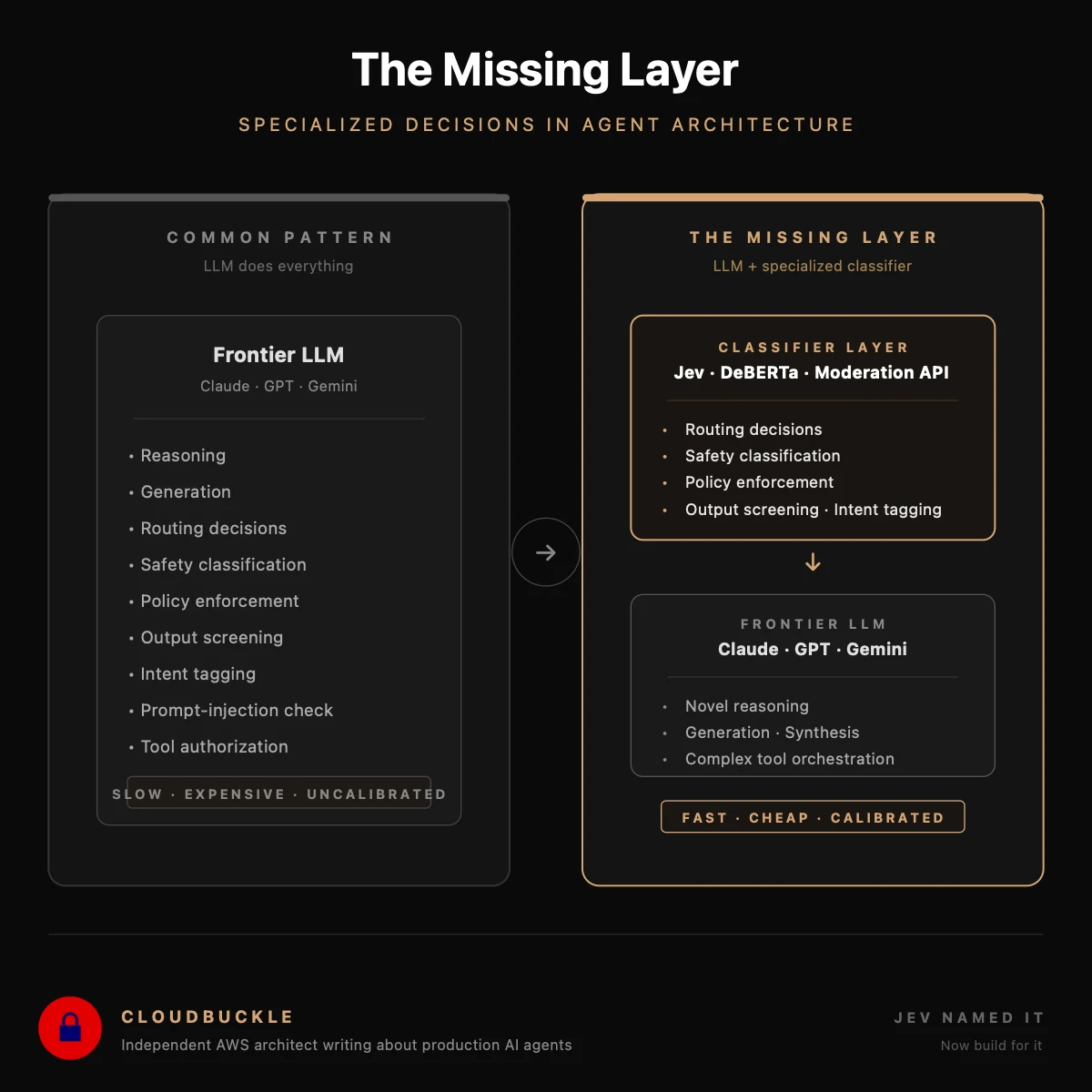
TypeSafe shipped Jev, and within a week the AI feed produced its usual dozen "what is Jev" explainers. LangChain covered it. Pydantic added it to their model list. Latent Space got Diogo Almeida on the podcast. That work is done. If you want to know what Jev is, you have twelve good options.
I want to write about a different question. What is Jev naming?
Because the description of Jev, sub-second responses, calibrated probabilities, typed outputs, no text generation, is not the interesting part. The interesting part is that the AI agent stacks I have been reviewing for the last two years route every single decision through a frontier LLM by default. Routing choices. Guardrail evaluations. Safety classifications. Policy enforcement. Content tagging. Output screening. All of it goes to Claude or GPT because the model is what the team already integrated. And a lot of those decisions are not reasoning problems. They are classification problems that a specialized model handles in 100 milliseconds for a fraction of the cost.
Jev is a specific product. The pattern it names is much bigger.
What Jev is, briefly
For anyone who missed the launch. Jev is a decision model from TypeSafe AI. It answers three shapes of question. Choice, where you supply a set of options and it picks one with a confidence score. Score, where you provide a scale and it rates the input against that scale. Yes or no, called Noul by TypeSafe, where you get a calibrated probability that the answer is true. Responses come back in 70 to 500 milliseconds. It does not generate text at all.
The founder is Diogo Almeida, previously on the RLHF team at OpenAI. TypeSafe raised $40M seed. The pitch is that Jev is 40-200 times faster and 40-400 times cheaper than frontier LLMs on the class of questions it answers.
Take the pricing and speedup claims with skepticism. TypeSafe acknowledged in the launch post that their benchmarks likely represent the high end of what users will see, and there is no published paper on the training method. The category argument is what to pay attention to, not the specific vendor's numbers.
What Jev is naming
The category is decisions that do not need reasoning.
Most production agent architectures I have reviewed have decision points that look like this. A user request comes in. Before the LLM does the actual reasoning work, the system needs to answer things like. Is this request within scope for this agent? Is the user authorized to trigger this tool? Does this input contain a prompt-injection attempt? Which of my four backends should this route to? Should this response be blocked before it goes to the user? Is this a duplicate of a request we processed 10 seconds ago?
None of those are reasoning questions. They are classification questions. The right answer for each is either yes or no, one of N choices, or a score from a scale. A well-tuned classifier answers them faster than an LLM's network round-trip, more reliably, and with a probability score that is actually calibrated. An LLM will answer them too, but slower, more expensively, and with less predictable output typing.
Every architecture I have seen in the field routes these decisions to Claude or GPT anyway. Not because that is the right tool. Because it is the tool already integrated.
Why LLMs are the wrong tool for these decisions
Four reasons that stack.
Cost. A yes-or-no question through a frontier LLM costs meaningfully more per invocation than a specialized classifier. At production scale, when every user request triggers three or four guardrail evaluations, that cost compounds fast. This is the cost containment guardrail in a form most teams do not notice.
Latency. An LLM answering a routing decision adds hundreds of milliseconds or more of network and inference time to every request. For anything user-facing, that is real product-quality tax. For batch workloads it is a real throughput ceiling.
Uncalibrated confidence. When an LLM says it is "confident" about a classification, that confidence is a token, not a probability. There is no reliable mapping from what the LLM says to whether it is actually right. Specialized classifiers with proper training on calibration produce probabilities you can threshold against. That difference matters enormously for anything that gates action.
Non-deterministic output shape. Ask an LLM to return "yes" or "no" and you will get "Yes," "yes," "Yes.", "Yes, based on the following analysis..." A specialized decision model with typed outputs cannot produce that variability by construction. Every downstream branch in your code that parses the LLM's output is a place a specialized classifier would have removed a whole class of bugs.
The pattern is older than Jev
Nothing I am describing is new. Specialized classifiers have been the right tool for classification problems for a long time. What has been missing is the naming.
DeBERTa is a general-purpose encoder model that ships fine-tuned checkpoints for most standard NLP classification tasks. OpenAI's Moderation API is a specialized classifier for content policy violations. Cohere's Rerank is a specialized model for relevance ordering. Fine-tuned RoBERTa or DistilBERT models handle intent classification in production systems that predate the LLM era.
The pattern of "use the specialized model for the specialized problem" is basic ML engineering. What the LLM era did was collapse everything into one API, one tool, one abstraction. Team ships an agent. Agent needs to make a decision. Decision goes to the LLM the agent already uses. Nobody argues, because it works.
Jev's contribution is not the technology. It is naming the category with a product SKU that platform teams can point at and say "we are adding a decision layer, and this is what we are considering for it." That naming is what makes the pattern visible to teams who were not going to fine-tune DeBERTa themselves.
Where the missing layer belongs in architectures I have written about
Every CloudBuckle piece from the last six months has decision points that fit this shape. Making them explicit.
The Claude Apps Gateway has routing decisions on every request. Which upstream model should this go to? Bedrock in region A, Bedrock in region B, or Claude Platform on AWS? The gateway does this via configuration rules. A specialized decision model could route based on request features (length, expected latency, historical spend for this user) instead of static rules. Choice-shaped.
The FinOps Agent has safety screening on every generated action. Before it opens a Jira ticket or posts to Slack, something needs to decide if the message is safe to send. A specialized decision model would be a yes-or-no call on every output. Cheaper, faster, more consistent than the same call to a frontier LLM.
The agent-readiness framework has guardrail evaluations at every write action. Blast radius: is this action within the allowed scope? Identity: is this actor allowed to trigger this? Human-in-the-loop: does this need approval? All yes or no. All answered in most deployments by whatever mechanism the team put together, often an LLM prompt that reads the action and returns a JSON blob that the calling code then parses back out.
Every one of those decisions is a candidate for the specialized-classifier layer. The LLM stays in place for the reasoning work. The classifier layer handles the decisions that gate it.
What is still open with Jev specifically
The category argument is real. The specific vendor argument is not proven.
TypeSafe has not published a training paper. Their benchmark numbers are self-reported and they acknowledge the numbers likely sit at the high end of real-world performance. The "40-200 times faster and 40-400 times cheaper" claim needs independent validation before anyone builds a production dependency on Jev specifically.
For a proof-of-concept or a low-stakes routing decision, trying Jev makes sense. For a production guardrail that stops a customer-facing agent from doing the wrong thing, I would want an independent benchmark first. Or I would build the decision layer with a fine-tuned model I control, and revisit Jev when third-party evaluation catches up.
The point is not that you should use Jev. The point is that you should have a specialized-decision layer at all. Jev is one option. DeBERTa is another. OpenAI's moderation API is another. Fine-tuning your own model is another. Pick the one your team can operate.
Three patterns worth using
Pattern 1: Sync-thin classifier fast path. Every user-facing agent request runs through a classifier layer before the LLM. Scope check, safety check, intent classification, tool authorization. All in the first 100-200 milliseconds. The LLM only fires on requests that pass the classifier gates. This is the shape I have been arguing for with sync-thin, async-fat splits, taken one step further. The sync path gets even thinner as classifiers take over the pre-flight decisions.
Pattern 2: Fine-tune-then-buy decision curve. For any decision that repeats often enough to justify the operational cost, fine-tune a small model on your own decision history. For lower-volume decisions where the operational cost is not justified, buy a decision API. Jev is a decision API. So is OpenAI Moderation. Draw the fine-tune-vs-buy line at the volume where fine-tuning pays back.
Pattern 3: Calibration-first for anything that gates action. If a decision determines whether an action fires, the confidence score matters as much as the decision itself. An 80% confident block is a different policy from a 51% confident block. Specialized classifiers with calibrated outputs make this policy expressible. LLM classifications do not, because LLM confidence is not calibrated. Anywhere your agent policy would benefit from "block if confidence above X" logic, you need calibrated outputs.
The bottom line
Jev arrived, got its explainers, and will get its "who won the launch cycle" post-mortems. The pattern it names is older, bigger, and largely missing from production agent stacks I review. Specialized decision models belong alongside your LLM, not in place of it. The LLM does the reasoning. The classifier layer does the gating. Nothing you build should have Claude or GPT answering "yes or no" or "one of three options" if you have alternatives you can operate.
Whether the specialized layer runs on Jev, on DeBERTa, on a fine-tuned RoBERTa, or on OpenAI's moderation API depends on your team and your workload. What matters is that the layer exists at all.
TypeSafe named it. Now build for it.
Written by Ramesh Nori. If this was useful or you have feedback, reach me at cloudbuckle@gmail.com.