AWS · Agentic AI · Production AI · FinOps · AI Architecture · Enterprise AI · Cost Management · IAM
AWS Shipped a Production Agent. Here's How It Scores Against the Agent-Readiness Framework.
By Ramesh Nori · August 10, 2026 · 10 min read
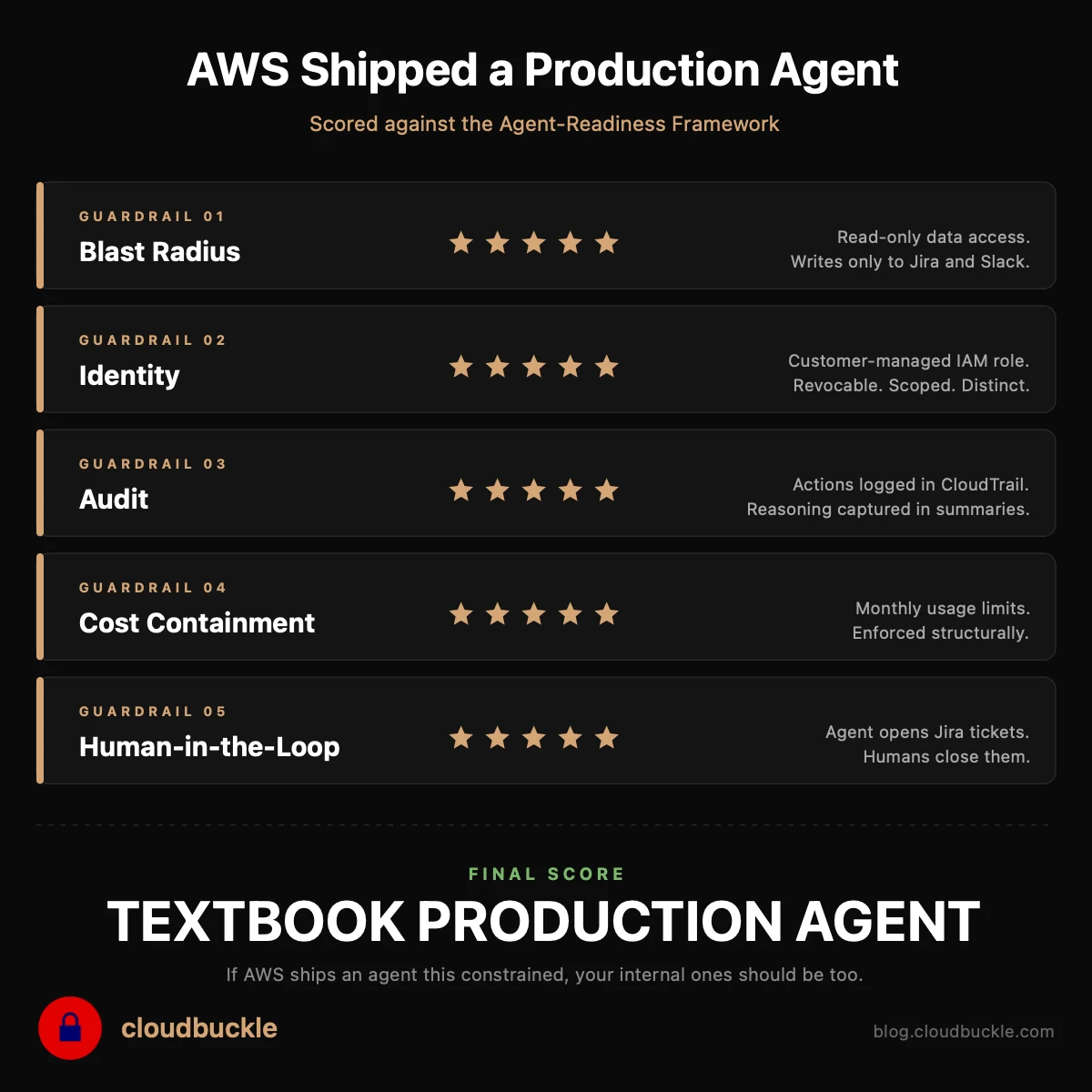
When we wrote the agent-readiness piece, we argued that shipping a production AI agent is less about the model and more about five guardrails: blast radius, identity, audit, cost containment, and human-in-the-loop. Most of the pushback we got on that piece was that the guardrails sounded reasonable in the abstract but nobody had shipped a real agent that showed all five in action.
Then AWS shipped the FinOps Agent in public preview.
This is interesting for two reasons. First, AWS almost certainly has more agent-safety telemetry than any single team building on top of them. What they chose to constrain is a signal about what actually matters. Second, the FinOps Agent is a small, testable case study: a bounded domain, a public spec, a customer-managed IAM footprint. Scoring it against our framework is a useful exercise because it turns theory into a concrete rubric applied to a real product.
The short version of the score is 5 out of 5 across every guardrail. The longer version is where the interesting design decisions live.
A quick refresher on the five guardrails
From the earlier piece, briefly: blast radius is the worst thing the agent can do given its permissions. Identity is who the agent is acting as. Audit is whether you can reconstruct what the agent did and why. Cost containment is what stops a runaway bill. Human-in-the-loop is where a person still has to nod before something irreversible happens.
If you have not read the original piece, you can skip back to it. What follows assumes you know the shape of the framework.
What the FinOps Agent actually does
A brief description before we score. The FinOps Agent investigates cost anomalies by correlating spend movements with CloudTrail events to identify the change that drove a cost spike. It answers natural-language cost questions across your workloads using Cost Explorer, Cost Anomaly Detection, Cost Optimization Hub, and Compute Optimizer as its data sources. It can take a small set of write actions: opening Jira tickets, posting to Slack channels, and generating scheduled cost reports in a presentation-ready format.
You interact with it through a web application, and it integrates with Jira and Slack for delivery. Setup involves a one-click IAM role provisioning in your management account. During the public preview, usage is free with monthly limits. Regional availability is limited to US East (N. Virginia).
That is the surface. Now the scoring.
Guardrail 1: Blast radius. Score: 5/5.
Blast radius is the "what is the worst thing this agent can do" question. AWS's answer is remarkably narrow.
The agent's data access is read-only across the AWS surface. It reads cost data, CloudTrail events, and optimization recommendations. It does not read S3 objects. It does not read customer databases. It does not read the contents of your applications.
Write actions are equally restricted. The agent can open Jira tickets, post to Slack, and generate reports. That is the entire write surface. Notably, the agent cannot modify IAM policies. It cannot change budgets, adjust tags, resize instances, or take any remediation action on your AWS resources directly. Even though the agent's whole job is helping with cost, it does not have permission to actually reduce cost by touching your infrastructure. That is a deliberate choice.
The worst-case outcome of a misbehaving FinOps Agent is an annoying Jira ticket, a wrong Slack message, or a misleading report. None of those are production-breaking. None of them require an incident response. This is the "small blast radius, ship it" configuration.
The pattern to notice: read from AWS, write only to notification systems outside AWS. If you are designing your own internal agent, this is a very defensible starting point. The agent can observe everything, communicate freely with humans, and touch nothing.
Guardrail 2: Identity. Score: 5/5.
The agent has its own IAM role, provisioned as a customer-managed role in your account. It is not a shared service account. It is not running under a human user's credentials. It has an identity you can revoke without affecting anything else in your account.
Every action the agent takes is attributable to that specific role in CloudTrail. When something goes wrong, "the agent did it" is not the answer. "The AWSServiceRoleForFinOpsAgent role called GetCostAndUsage at 14:32" is.
This is the identity guardrail done properly. The lesson generalizes. On day one of any agent build, give it its own IAM role. Not a shared service account. Not credentials borrowed from a human. A named identity with the smallest scope of permissions it needs to function. This is not optional and AWS's own agent proves it is not expensive.
Guardrail 3: Audit. Score: 5/5.
The audit story has two parts, and AWS handled both.
The first part is action logging. Every call the agent makes lands in CloudTrail attributed to its IAM role. This is table stakes and AWS obviously ships it correctly.
The second part is the one most agent designs skip. The FinOps Agent produces investigation summaries when it looks into an anomaly. These summaries document not just what the agent did, but what it looked at, what it concluded, and why. That is a reasoning trace, not just an action trace.
The distinction matters. Action logs tell you the agent called GetCostAndUsage and then opened a Jira ticket. Investigation summaries tell you the agent noticed a 2,000 spike on a specific service, correlated it to a CloudTrail event where someone launched a p4d instance, and concluded that the instance was likely the cause. Those are two different kinds of evidence, and both matter when you are answering "why did the agent do this" during a review.
If you take one thing from this scoring exercise, take this: your agent's audit story is incomplete if it only captures actions. The reasoning is where the actual liability lives. Build for it.
Guardrail 4: Cost containment. Score: 5/5.
There is real irony here. The FinOps Agent is an agent whose entire purpose is helping with cost, and it operates under strict cost limits itself. AWS put explicit monthly usage limits on the preview.
The agent's runtime cost profile is inherently cheap. It reads from AWS APIs, most of which have generous free tiers or negligible per-call costs. It generates natural language answers, which is a bounded model inference cost per query. It does not loop indefinitely on ambiguous data because there is a limit on how much data it will process per query.
The pattern to notice: even a low-risk read-only agent has a monthly ceiling. AWS is not banking on "our agent is well-behaved" to keep costs under control. They are enforcing it structurally.
If your internal agents do not have hard ceilings on model calls, tool calls, tokens, and runtime, you are trusting the design of the agent to keep costs bounded. AWS did not trust their own design that much. You should probably not trust yours more.
Guardrail 5: Human-in-the-loop. Score: 5/5.
This is the guardrail where AWS made the most interesting choice.
The FinOps Agent can open a Jira ticket. It cannot close one. It can post to Slack. It cannot act on Slack decisions. It surfaces cost anomalies, but it does not remediate them. The agent's write authority stops at "tell a human something might be wrong."
Look at what AWS did not build. They did not build an auto-remediation feature that shuts down unused instances. They did not build an agent that changes budgets or reallocates spend. They did not even build the ability to close a ticket the agent opened. Every meaningful action that affects your AWS environment stays with a human.
AWS chose "assist" over "act." The agent's job is to surface, humans do the fixing. This is not a limitation of the preview. This is the intended shape of the product.
The lesson: for a huge category of internal agents, the right design is not "agent that fixes the thing." It is "agent that finds the thing and hands off." The hand-off is the guardrail. Skipping it does not make your agent more useful. It makes it more dangerous.
What AWS got right, in one paragraph
Five out of five on every guardrail is not an accident. The pattern is coherent: read broadly from AWS, write only to notification systems outside AWS, log both actions and reasoning, cap the runtime cost structurally, keep humans in the write path for anything that affects the environment. Every design decision points the same way. This is what an agent looks like when the people shipping it are the same people who will get paged if it does something wrong.
What's still open
The 5-out-of-5 score is honest, but it is worth being explicit about what the framework does not cover and where the FinOps Agent leaves work for the user.
Regional availability. Public preview in us-east-1 only. If your management account lives elsewhere, this affects deployability and blast radius calculations. Not a design flaw, but a real constraint.
Prompt injection surface. The agent accepts natural language input. AWS's announcement does not discuss how the agent handles adversarial prompts. A cost query crafted to trigger unexpected tool calls or surface data outside the requester's intent is a real concern for any natural-language agent, and the five guardrails as we wrote them do not fully cover it. Prompt injection deserves its own analysis, and we would not score any agent 5/5 on adversarial resistance without seeing evaluation data.
Preview state. The current pricing model (free with monthly limits) is a preview artifact. The pricing model at general availability is unknown. This does not change the design, but it changes the cost containment story once the free tier ends.
Forward-looking cost governance. The FinOps Agent explains historical spend well. It does not proactively govern future spend, which some would argue is the actual FinOps job. The agent is a reporter on cost, not a governor of it. That is a scoping choice, but worth naming.
Concentration in the management account. Adding the FinOps Agent to your management account increases the responsibilities living there. The blast radius of the account itself gets a small bump. Not a reason to skip the agent, but worth accounting for in a mature multi-account strategy.
Three patterns worth copying
If you take three specific patterns from this scoring exercise into your own agent designs, take these.
Pattern 1: Read from your infrastructure, write to notification systems.
The strongest single design decision AWS made is this asymmetry. The agent reads freely across AWS. It writes only to Jira and Slack. This inversion (read broad, write narrow, and specifically write outside the system you are reading from) collapses the blast radius to something manageable. For most internal agents, this is a fine starting point. Escalate to write access on your infrastructure only when the read-only pattern is proven safe on real traffic.
Pattern 2: Give the agent its own IAM role on day one.
Not a shared service account. Not credentials borrowed from a human. A customer-managed role with a name that identifies which agent is using it. Every action attributable, every permission scoped, every credential revocable. This is not clever architecture. It is basic hygiene, and AWS's own agent does it because agents that do not do it are not shippable.
Pattern 3: Log the reasoning, not just the actions.
Action logs tell you what happened. Reasoning logs tell you why. When something goes wrong, the reasoning is what lets you diagnose whether the agent was working as designed or off-script. Investigation summaries are the model AWS chose. Whatever form yours takes, capture the why, not just the what.
The bottom line
The FinOps Agent is closer to the Forward Deployed Engineer role we described in the architect-PM-FDE trilogy piece than to a chatbot or a copilot. It sits next to your workflow (Jira, Slack), it investigates in the field (CloudTrail correlation), it surfaces findings, and it hands off to humans. The pattern is not new. AWS just gave it a well-designed IAM footprint and a bounded write surface.
AWS shipped a textbook agent. Not because they could not make it more powerful, but because they know what makes an agent safe to ship. If AWS is this cautious with an agent operating on their own APIs, using their own infrastructure, running in their own preview environment, your internal agents should probably be at least this cautious.
The framework was never ours. It is the shape of every agent that ships responsibly. The FinOps Agent just made that a lot easier to point at.
Written by Ramesh Nori. If this was useful or you have feedback, reach me at cloudbuckle@gmail.com.