AI Architecture · Vendor Risk · Multi-Model Fallback · AWS Bedrock · Anthropic · Enterprise AI · AI Strategy · Regulatory Risk
Vendor Risk Used to Be a Procurement Problem. After Fable 5, It's an Architecture Problem.
By Ramesh Nori · June 30, 2026 · 10 min read
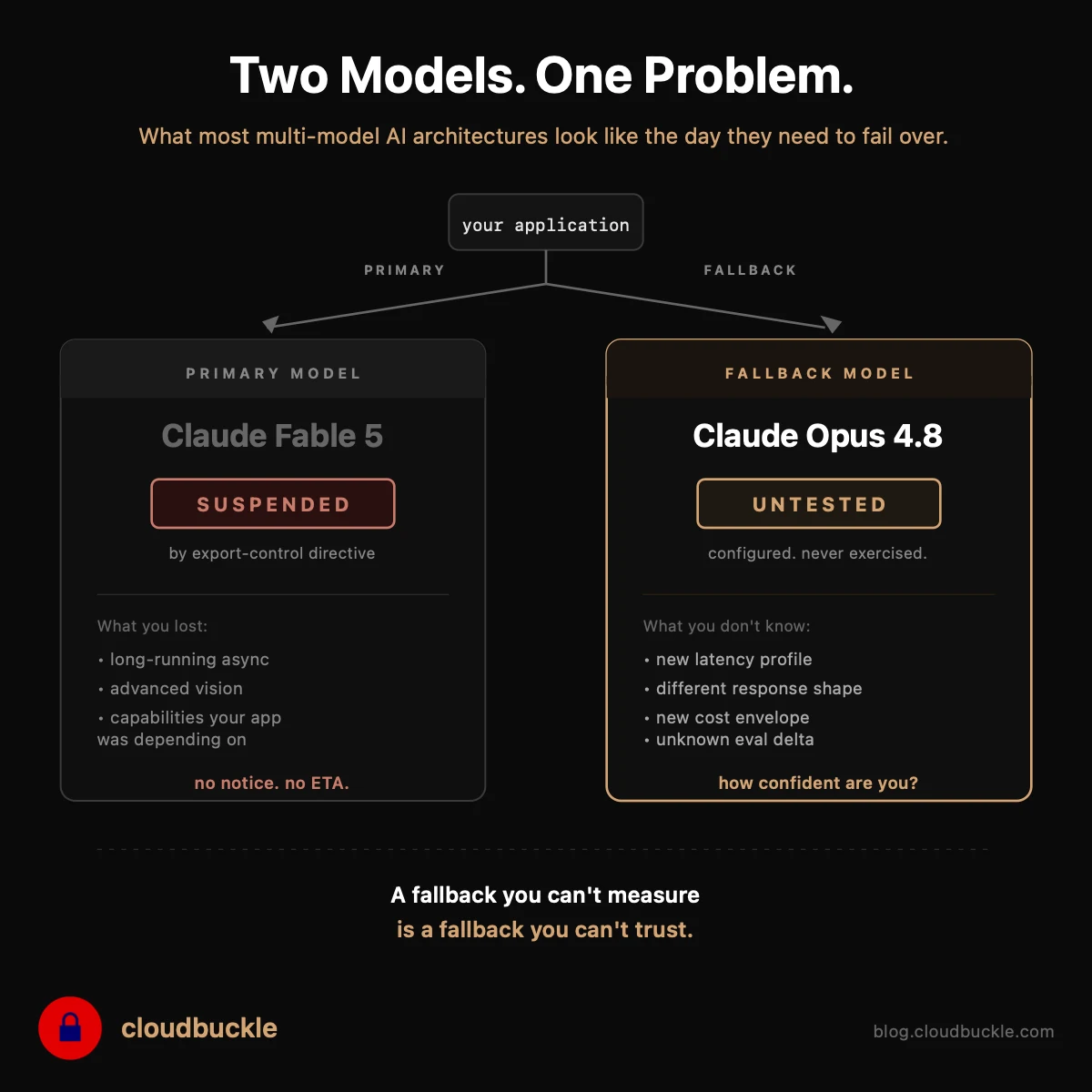
The Fable 5 suspension is going to be remembered as a regulatory story. For most readers, it should be remembered as an architecture story.
The short version: on June 12, 2026, the US Commerce Department issued an export-control directive requiring Anthropic to suspend access to Claude Fable 5 and Claude Mythos 5 for foreign nationals. Anthropic could not filter foreign access in real time and suspended both models globally pending the review. We wrote up the architectural implications of Fable 5 when it shipped. Three days later, the model was unavailable.
This is not about Anthropic. It is about your architecture.
For most of the cloud era, "vendor risk" meant pricing changes, model deprecation cycles, and switching costs. Real, but manageable. The Fable 5 suspension revealed a bigger category that most enterprise AI architectures have not planned for: a frontier model can be turned off by a regulator you do not sell to, with no notice, no ETA, and no recourse.
This applies to every provider, every cloud, every frontier model. Fable 5 was not the exception. Fable 5 was the proof.
What changes architecturally
Four patterns shift the moment you take vendor regulatory continuity seriously. None of these are exotic. Most teams have heard of all of them. The change is that they move from optional optimizations to required architecture.
Pattern 1: Multi-model fallback stops being a cost decision
Multi-model fallback used to be a cost optimization. Route easy queries to Haiku, hard ones to Opus. Save money. Most teams treated it as a "phase 2" feature.
It is now a continuity requirement. If your primary model goes offline for an unknown duration, what happens to your application? "It stops working" is not an acceptable answer when the cause is outside your control and the timeline is outside your knowledge.
The good news: Bedrock's Converse API normalizes inputs across models, which gives you most of the surface area you need to fail over. The hard news: configurable fallback only works if your evals, prompts, and tool definitions actually work against the fallback model. Most teams configure the fallback once, never test it on real traffic, and discover on the day they need it that the system behaves differently than they expected.
Pattern 2: API surface area becomes a strategic decision
Two paths to call a model on Bedrock matter for very different reasons now.
If you wrote against the Anthropic SDK directly, taking advantage of Anthropic-specific capabilities (long-running async, specific tool-use envelopes, native vision), switching to a different provider has more friction. You traded portability for capability.
If you wrote against the Converse API, you have portability across providers, but you give up the parts of any one provider's surface that are not in the common subset. You traded capability for portability.
There is no wrong answer. There is a wrong assumption, which is that you are not making the choice. Architects need to make this decision deliberately, in writing, with the regulatory continuity question on the table. If your application depends on a provider-specific capability that does not exist on the fallback, your fallback is not a fallback. It is a hope.
Pattern 3: Eval portability becomes a feature, not a nice-to-have
We've written that eval design is the new spec writing. The spec now has to include degraded operation.
Your eval set should run against the fallback model. Same prompts, same expected behaviors, same rubric. The results will be different. They should be different. The point is to know how different so your application can absorb the gap.
A team that has a 92% pass rate on Opus and an unknown pass rate on Haiku has a fallback they cannot trust. A team that has 92% on Opus and 81% on Haiku has a fallback they can reason about: "we drop accuracy by 11 points on degraded mode, here is how we tell the user, here is what we do about the cases that newly fail."
A fallback you can't measure is a fallback you can't trust.
Pattern 4: Cost predictability has a new dimension
The cost ceiling we wrote about in the agent-readiness piece needs a second axis now.
If your primary model is unavailable for an unknown duration and your traffic falls back to a more expensive model, your monthly bill changes. By how much depends on the fallback's pricing, how long the suspension lasts, and how much of your traffic flows through the affected workload.
The fix is not complicated. Cost ceilings have to be designed for the fallback envelope, not just the primary. The CFO question "what happens to our AWS bill if we are on the fallback model for a month" should have an answer that exists before the answer is needed.
What fallback actually looks like in production
Fallback is harder than configuration. The honest version, from where we've seen it work and break.
Capability gaps are behavior changes, not quality changes. A model with long-running asynchronous execution falling back to a model without it is not "the same product, slightly worse." It is a different product. Your application code has to handle both flows, not just the happy path.
Latency profile shifts. Fallback models have different p95 and p99. The UX has to absorb that. A 2-second answer becoming a 9-second answer breaks the chat experience even if the answer is correct.
Response shape varies. JSON schemas, tool-call envelopes, refusal patterns, and safety routing behavior differ between models. Your output parsers and downstream code need to be model-agnostic, or your fallback path is going to throw exceptions you have never seen before.
Degraded mode signaling matters. Does the user know they are on the fallback? Should they? The answer depends on the use case. For a coding assistant, probably not. For a healthcare summary, probably yes. The PM has to decide and the architect has to wire it in.
The hardest part: continuity rehearsal
Most teams configure multi-model fallback once and never test it again. The fallback works in the unit test, sits in the configuration file, and is never exercised against real production traffic.
That is not a fallback. That is a hope.
The Fable 5 suspension is the example architects should point at when asking for budget to rehearse the fallback. Real-world tests of vendor continuity can come without warning, from outside your control, on a timeline you do not get to negotiate.
Continuity rehearsal looks like this in practice. Pick a quarterly cadence. Pick a window (a few hours, scaling up to a day as confidence grows). Route real production traffic through the fallback for that window. Watch what breaks. Fix it. Document it. Repeat.
This is how operations teams have rehearsed disaster recovery for decades. AI architectures need the same discipline. The frequency is what matters. A fallback that has been exercised on real traffic this quarter is a real fallback. A fallback that has not been exercised since it was configured is a configuration file.
What to do this quarter
A concrete checklist. Things that should be on an architect's calendar before the next week ends.
- Audit your model dependencies. Which model is your primary? Your fallback? Have you actually tested the fallback on production traffic, or only on test traffic? Write the answers down.
- Run your eval set against the fallback model. Compare the numbers honestly. Where the gap is significant, decide what your application does about it.
- Read your Bedrock and provider terms. Understand what they actually cover before you assume something will. The terms exist for a reason and architects should know what they say.
- Define your degraded mode UX. What does the user see when you are on the fallback? Is the experience honest about it? Is the PM aware?
- Schedule a quarterly continuity rehearsal. Put it on the calendar before something else does. The first rehearsal will surface problems. That is the point.
- Model the cost ceiling for the fallback envelope. What happens to your monthly bill if the fallback runs for a month? Who knows that number besides finance?
None of these are expensive. All of them are valuable. Most of them have a one-week implementation horizon.
The bigger picture
This is not a one-vendor story. Every frontier model from every provider is now subject to the same category of risk. The next regulatory event might land on a different model, a different provider, a different jurisdiction. The pattern is what matters, not the specific vendor.
Concentration risk is the next thing to think about. If every team's fallback plan is "fail over to Opus," and Opus has its own regulatory moment, the fallback is gone for the same reasons the primary was. The fix is regulatory diversity, not just model diversity. That is harder than it sounds and is going to be one of the architecture conversations of the next two years.
The strategic read: AI architecture resilience now depends on regulatory diversity across providers, not just model selection within a provider. This is uncomfortable to plan for. It is also the honest read of what the Fable 5 suspension revealed.
The bottom line
The Fable 5 suspension did not create vendor regulatory risk. It revealed it.
Most AI architectures were betting on regulatory continuity without naming the bet. The bet might still pay off. The model might come back next week, or it might not. Either way, continuing to leave that risk unmodeled is no longer responsible architecture.
The architect's job is to model the risks nobody else is modeling. This is one of them.
Written by Ramesh Nori. If this was useful or you have feedback, reach me at cloudbuckle@gmail.com.