AI Systems Architect · Future of Work · AI Governance · Career · Agentic AI · Human-in-the-Loop
The AI Systems Architect: A Roadmap for the Next 3 to 5 Years
By Ramesh Nori · May 8, 2026 · 8 min read
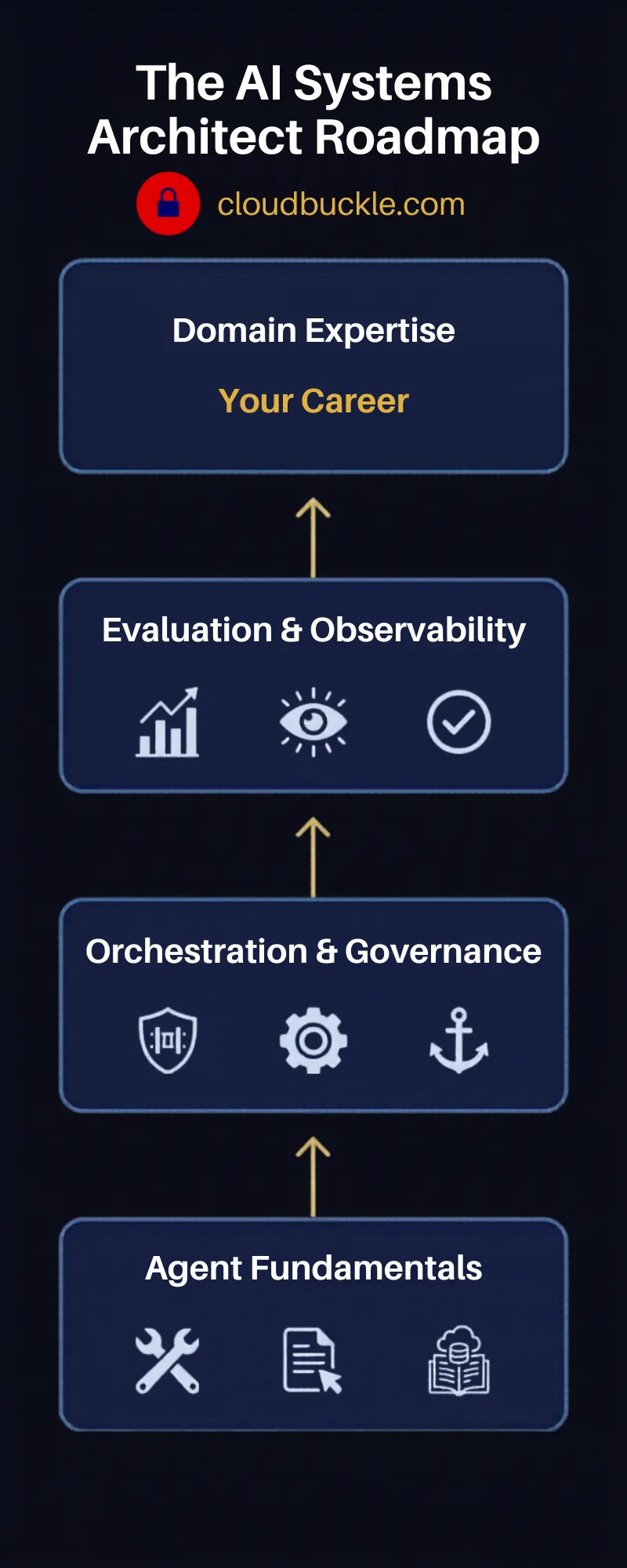
I posted something on LinkedIn last week about the shift happening in tech hiring. The response surprised me. Dozens of engineers and product managers reached out asking the same question: "How do I become an AI Systems Architect? What's the roadmap?"
The question tells me something important. People can feel the shift coming. They just don't know what to do about it.
So here's my honest take, based on what I'm seeing across client engagements and the talent market right now.
The shift that's already underway
Companies are aggressively experimenting with agentic AI to replace execution-based roles. Code generation, test writing, ticket routing, report generation. Tasks that used to require a person now run through an agent pipeline.
Some of this works. A lot of it doesn't. But the experimentation isn't stopping.
What companies are discovering is that the hard part isn't building the agent. It's governing it. Every organization that goes past the demo stage hits the same wall: the systems get complex, hallucinations creep in, context gets lost between agents, and nobody knows why the system made a specific decision last Tuesday.
That wall is where the AI Systems Architect role lives.
What is an AI Systems Architect?
It's the person who understands how to build, audit, and course-correct autonomous agent pipelines. Not just the code. The entire system: how agents reason, how they interact, where they fail, how you catch those failures, and how you keep humans in control.
This role doesn't exist in most org charts yet. But the need is real. Every company running AI agents in production needs someone who can answer:
- Why did the agent make that decision?
- Is the system getting better or worse over time?
- Where do we need human oversight and where can we let the agent run?
- What happens when the model provider ships an update that changes behavior?
- How do we prove to regulators that our AI is operating within bounds?
If nobody in the room can answer these questions, the company is flying blind.
The four layers of the roadmap
Layer 1: Agent fundamentals
You need to understand how agents actually work under the hood. Not just how to write a prompt. How the full system operates.
This means understanding:
- How models reason through multi-step problems
- How tool use works (the model generates a function call, your code executes it, the result feeds back)
- How prompt chaining breaks complex tasks into debuggable steps
- How context windows limit what an agent can process and what to do about it
- How RAG gives agents access to your organization's specific knowledge
If you can't explain how an agent decides which tool to call and why, you're not ready to architect a system of agents.
Where to start: Build a single agent that does one useful thing. Not a chatbot. An agent with tools that takes real actions. Process a document, query an API, generate a report. Get your hands dirty with the mechanics.
Layer 2: Orchestration and governance
A single agent is a toy. Production systems have multiple agents working together. This layer is about coordination and control.
You need to understand:
- How orchestrators dispatch work to subagents and collect results
- How to design agent boundaries (what each agent can and can't do)
- How guardrails work at the platform level (Bedrock Guardrails) and the application level
- How to ground agent outputs to verified data so you can trust the results
- When to use static orchestration (predefined workflow) vs dynamic orchestration (AI decides the workflow)
Most teams get stuck here. They build agents that work individually but fall apart when combined. The orchestration layer is where architectural thinking matters more than coding skill.
Where to start: Take your single agent and split it into three subagents coordinated by an orchestrator. You'll immediately feel the complexity. That feeling is the gap this layer fills.
Layer 3: Evaluation and observability
This is the layer most teams skip entirely, and it's the one that separates production systems from demos.
You need to understand:
- How to build evaluation datasets from human-reviewed outputs
- How to measure precision (is the agent right when it flags something?) and recall (does the agent catch everything it should?)
- How to trace agent decisions through multi-step workflows so you can debug failures
- How to detect regressions when you update a prompt, change a model, or modify a subagent
- How to set up alerts that tell you the system is degrading before users notice
An AI Systems Architect who can't measure system quality is like a pilot who can't read instruments. You might fly fine on clear days. You'll crash when it gets cloudy.
Where to start: Run your agent on 20 inputs where you already know the correct answer. Measure how often it gets the right result. Change a prompt and run it again. Did the numbers go up or down? Congratulations, you just built your first evaluation pipeline.
Layer 4: Domain expertise
This is the layer nobody can teach you.
AI without domain context is a liability. An agent that processes medical records needs someone who understands healthcare compliance. An agent that reviews financial contracts needs someone who understands lending regulations. An agent that manages supply chain logistics needs someone who understands the operational constraints.
The companies that will thrive in the AI era won't be the ones with the best models or the most agents. They'll be the ones where the people governing those agents deeply understand the business domain the agents operate in.
If you're a healthcare engineer, your clinical knowledge combined with AI systems skills makes you irreplaceable. If you're a fintech product manager, your regulatory knowledge combined with agent governance skills puts you in a category most pure technologists can't reach.
Where to start: You already have domain expertise from your career. The roadmap isn't about abandoning it. It's about adding the AI systems layer on top of what you already know.
The hiring shift
What I'm seeing in the market right now:
Declining demand: Pure execution roles. Write this code, manage this sprint, run this test suite. Agents are absorbing this work faster than most people expected.
Rising demand: Judgment-based roles. Evaluate whether this agent is making good decisions. Design the governance layer. Build the human-in-the-loop workflows. Audit the system for bias, drift, and failure modes.
The job title might be AI Systems Architect, AI Governance Lead, Agent Operations Manager, or something that doesn't exist yet. The underlying skill set is the same: someone who can build, measure, and govern autonomous AI systems within a specific business domain.
The companies that will win
They won't necessarily be the ones with the most advanced AI agents. They'll be the ones that build the best governance and human-in-the-loop layers.
An agent that makes decisions without oversight is a time bomb. An agent that makes decisions with proper guardrails, grounding, evaluation, observability, and human review at the right moments is a competitive advantage.
Building that governance layer is the AI Systems Architect's job.
Where to go from here
We published a free 12-module series that covers the technical building blocks in depth: Agentic AI: 12 Building Blocks.
It covers layers 1 through 3 of this roadmap with a hands-on document processing workflow as the running example. Layer 4 is yours to bring.
The window for positioning yourself in this space is open right now. In three years, this role will be well-defined and the bar for entry will be much higher. The people who start building these skills today will have a significant head start.
Written by Ramesh Nori. If this was useful or you have feedback, reach me at cloudbuckle@gmail.com.