AI Readiness · Small Business · AI Strategy · Operations · SMB
The AI Readiness Check Every Small Business Should Do Before Spending a Dollar
By Ramesh Nori · May 8, 2026 · 7 min read
Every week someone asks me if their business is "ready for AI." Usually they've seen a competitor launch a chatbot or read an article about how AI is going to change everything. They want in.
My first question is always the same: "Tell me about the process you want to improve."
About half the time, there isn't one. They don't have a defined process. They have a vague idea that AI should help "somewhere" but they haven't figured out where. That conversation ends quickly.
The other half have something real. A workflow that runs every day, a pain point they can describe in detail, a problem that's costing them time or money. Those are the businesses that are actually ready.
Here's how to figure out which one you are before you spend a dollar.
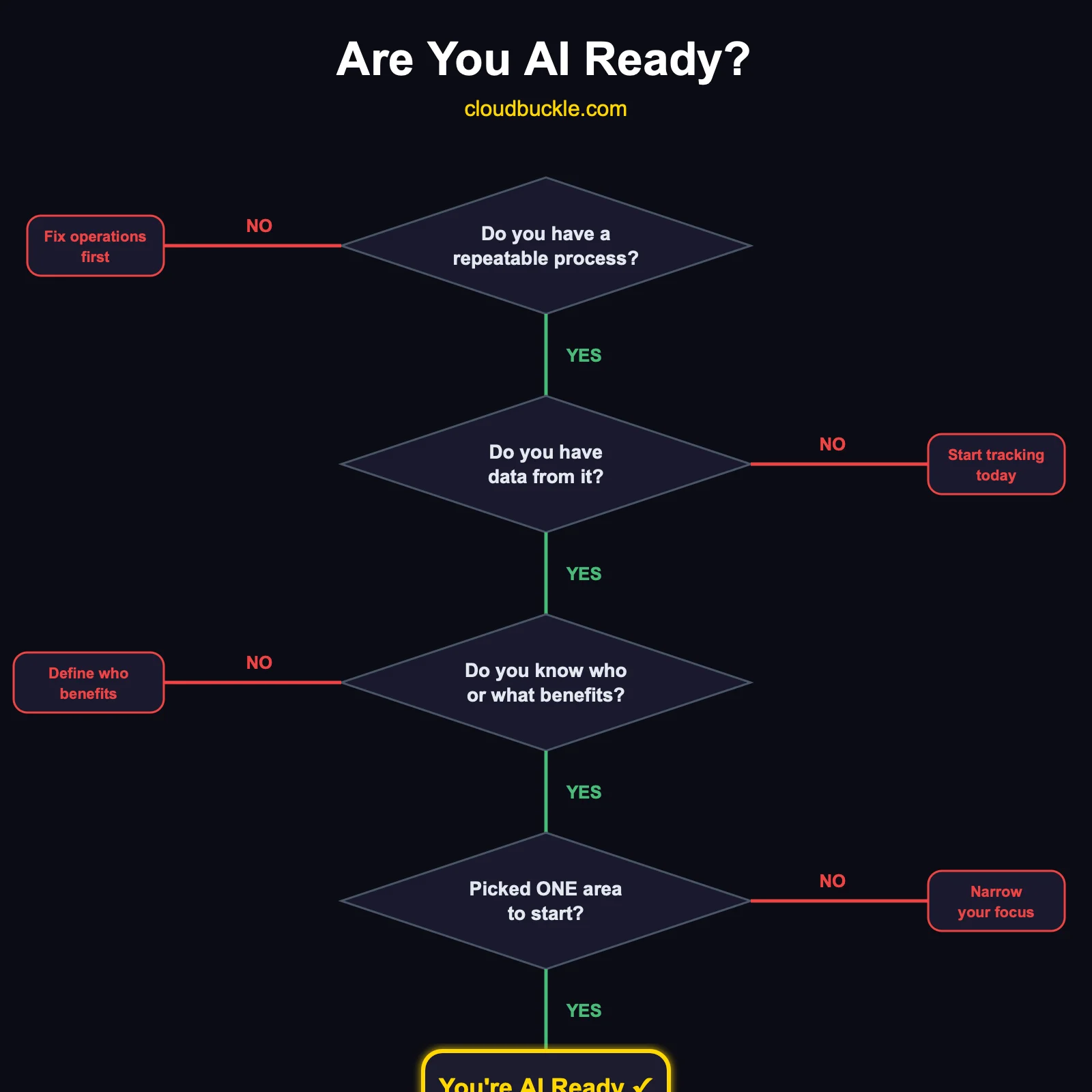
Do you have a repeatable process that already works?
This is the first filter and it eliminates most AI projects before they start.
AI doesn't create processes. It accelerates existing ones. If your team doesn't have a consistent way of handling customer inquiries today, an AI chatbot won't fix that. It'll just automate the chaos.
Ask yourself:
- Can you describe the process step by step?
- Does your team follow the same steps every time?
- Does the process deliver consistent results?
If the answer is yes, AI can make that process faster, cheaper, or available 24/7. If the answer is no, fix the process first. That's not an AI problem, that's an operations problem.
A landscaping company that has a solid booking workflow (call comes in, check availability, confirm the appointment, send a reminder) is ready for an AI agent that handles that same flow after hours. A landscaping company that handles every call differently depending on who picks up the phone is not.
Do you have the data to back it up?
AI runs on data. If your process exists but none of it is tracked or recorded, there's nothing for AI to learn from or work with.
Questions to ask:
- Are your customer interactions logged somewhere (CRM, spreadsheet, email, anything)?
- Do you have records of past transactions, orders, or service requests?
- Can you pull up data on what worked and what didn't over the last 6 to 12 months?
You don't need a data warehouse. You don't need a data science team. But you do need something. A well-maintained spreadsheet is enough to start. A CRM with 2 years of customer history is gold.
If your business runs on handshakes, phone calls that nobody logs, and sticky notes on a monitor, AI has nothing to work with. Start tracking before you start automating.
Do you know who or what benefits?
AI doesn't exist in a vacuum. It improves something for someone. Before you build, you need to clearly define who or what gets better because of it.
It might be your customers. It might be your internal team. It might be a product or a business process. The point is: you need a specific beneficiary, not a vague goal.
Think about:
- If it's for customers: Who are they? What are their top 5 questions or requests? Where do they get frustrated?
- If it's for operations: Which team is spending the most time on repetitive work? What would they do with 10 extra hours a week?
- If it's for a product: What's the one feature gap your competitors have solved that you haven't?
- If it's for a process: Which process breaks most often or costs the most to run?
"Our customers wait an average of 4 hours for a quote. We want that down to 10 minutes." That's an AI-ready problem.
"Our underwriting team manually reviews 200 documents a day. We want to automate the first pass." Also AI-ready.
"We want to use AI to improve the business" is not. It's too vague. Vague goals lead to expensive projects that deliver nothing.
Do you know your product?
Same idea, different angle. What exactly do you sell and where does friction exist in delivering it?
- Can you clearly describe each product or service you offer?
- Where do bottlenecks show up in delivering that product or service?
- What part of the delivery process is manual and repetitive?
An HVAC company that can say "we spend 3 hours a day creating quotes because every job requires a custom calculation based on square footage, equipment type, and local codes" has identified an AI-ready bottleneck. That calculation can be automated.
An HVAC company that says "everything takes too long" hasn't narrowed the problem enough.
Where do you actually want AI?
AI can touch almost every part of a business. But trying to do everything at once is how projects fail. Pick one area to start.
| Area | Example AI Use Case |
|---|---|
| Operations | Automate scheduling, inventory management, quality checks |
| Customer Service | After-hours call handling, FAQ chatbot, appointment booking |
| Sales | Lead scoring, follow-up automation, proposal generation |
| Marketing | Content creation, email personalization, social media scheduling |
| Product | Recommendation engines, search improvement, dynamic pricing |
Start with the area where you have the clearest process, the best data, and the biggest pain point. Get one win before expanding.
What's your budget and timeline?
Honest conversation time. AI solutions range from $50/month tools to $500,000 custom builds. Where you land depends on what you need.
Under $500/month: Off-the-shelf AI tools. Chatbots, scheduling assistants, email automation. No engineering required. Good for testing whether AI adds value to a specific workflow.
$5,000 to $25,000 (one-time): Custom AI solution for one specific workflow. An AI agent that handles your particular booking process, quote generation, or document processing. Requires someone who knows what they're doing.
$25,000+: Multi-workflow AI system with integrations into your existing tools (CRM, ERP, accounting). This is where you need architecture planning before building.
On timeline: a focused AI solution for one workflow can be live in 2 to 4 weeks. An enterprise-wide AI strategy takes months. Start small, prove value, expand.
The readiness checklist
Before you talk to any AI vendor, consultant, or tool provider, be able to answer yes to these:
- I can describe the exact process I want to improve, step by step
- I have data (even basic) from that process over the last 6+ months
- I know exactly who or what benefits from this improvement
- I know where the biggest bottleneck is
- I've picked one area to start (not "everything")
- I have a budget range in mind
- I have a realistic timeline (weeks, not days)
If you can check all seven, you're ready. If you can't, the ones you miss tell you exactly what to work on before bringing AI into the picture.
The biggest mistake I see
Small business owners buying an AI tool because a vendor told them they need it. The vendor shows a flashy demo. The owner signs up. Three months later nobody is using it because it didn't fit how the business actually works.
AI works when it plugs into a process that's already running. It fails when it's a solution looking for a problem.
Figure out the problem first. The technology part is the easy part.
Written by Ramesh Nori. If this was useful or you have feedback, reach me at cloudbuckle@gmail.com.